Drip irrigation for Dallas beds under twice-weekly watering rules
If your shrub beds struggle on a sprinkler schedule, putting the water at the roots may be the simpler answer.
October 14, 2026 · 4 min read
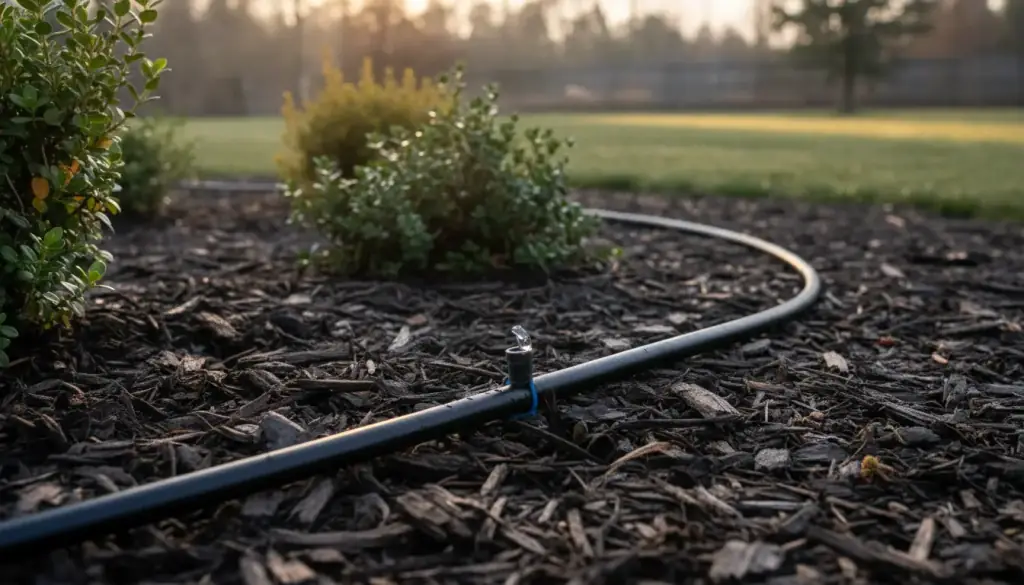
Dallas limits how often a typical sprinkler system can run, with a twice-per-week pattern at low-evaporation times. That works fine for turf, which can handle a deep soak every few days. It's harder on a shrub bed, where a sprayed mist lands on leaves, drifts onto the sidewalk and evaporates before the roots have a chance. If you've watched your foundation plantings sulk through August while the lawn next to them looks fine, the watering method is a likely culprit.
What drip actually does differently
A drip system runs low-pressure tubing through a bed with small emitters placed at the plants. Water leaves slowly and soaks straight down into the root zone. Nothing is flung into the air, so there's far less wind drift, less evaporation and almost no water landing on pavement or siding.
Precision Irrigation Systems describes drip as up to 97% water efficient, and says it uses 30 to 50% less water than conventional watering. Drip is also exempt from the Dallas city restrictions that limit sprinklers to two days a week. Rules change, so it's smart to confirm the current city requirements for your address, but drip is built for exactly this situation.
Where drip earns its place in a yard
- Foundation plantings and shrub beds, where spray heads end up wetting the house wall.
- Narrow strips between a driveway and a fence, where a spray pattern can't be aimed without overspray.
- Individual trees, which need slow, deep watering rather than a quick surface rinse.
- Flower beds and raised planters that need a steady supply without soaking the mulch.
- Commercial entrances, medians and planter beds, where water on a sidewalk is a nuisance and a slip risk.
There's a side benefit that surprises people. Because only the plants get watered, the bare soil between them stays dry, and far fewer weeds sprout. Less hand weeding is a real saving over a season.
Why drip gets its own zone
Drip and spray should never share a zone. Spray heads deliver water by the minute, in big volume. Drip delivers by the hour, in small volume. Run them on the same valve and one of the two will be either drowned or starved. A properly built system gives the drip lines their own zone, with their own run time, so the beds get a long, slow drink while the lawn gets a shorter one.
Drip also wants a little hardware that spray doesn't. A filter keeps grit from clogging the emitters. A pressure regulator brings the supply pressure down to what the tubing can handle. Skip either one and you'll be chasing leaks and blown fittings within a season.
Design choices that make drip last
Emitter placement is the part that deserves thought. A young shrub needs emitters near its trunk. A mature one needs them spread around the drip line of its canopy, where the active roots have traveled. A bed planted densely with perennials may need tubing laid in a grid instead of a single run. This is a design decision about your plants, not a one-size kit from a store shelf.
Cover matters too. Tubing left exposed in the sun gets brittle, and exposed lines get kicked, mowed or chewed. Burying it lightly under mulch protects it and slows evaporation further. The end of each line should have a flush point, so you can open it and clear sediment once or twice a year.
Keeping a drip system healthy
Drip is quiet, which is also its weak point. When a sprinkler head breaks, you see a geyser. When a drip line pops loose, you see a plant slowly declining a month later. A short routine catches the trouble early.
- Run the zone once a season and look for wet or dry patches along each line.
- Check that every emitter is dripping and that none are blocked or missing.
- Look for tubing that has been pulled out of position by mulching, digging or animals.
- Flush the ends of the lines and clean the filter.
- Adjust run time as plants mature and as the weather changes.
Because drip can be tied to the same automatic controller as the rest of the irrigation system, none of this requires you to stand outside with a hose. The schedule runs on its own, and you can adjust it as the seasons shift.
What to have ready for an estimate
A rough sketch of the beds helps, even a photo with a few notes. List the plants you know, the ones that struggle, and the places where your current sprinklers hit the wall or the sidewalk. If you have a controller with spare zone capacity, mention that too.
Precision Irrigation Systems installs and repairs drip irrigation for homes and commercial properties across Dallas and North Texas. The details are on the drip irrigation page at /services/drip-irrigation, and the office at (469) 534-1100 gives free estimates and replies to every inquiry within 24 hours.
Precision Irrigation Systems, (469) 534-1100
Call (469) 534-1100More articles
Why one corner of your lawn always browns first
The patch that quits first in July is telling you something about how the sprinklers were laid out.
Winterizing and spring setup for a North Texas sprinkler system
A little care at both ends of winter keeps cracked pipes and dead zones out of your first warm month.