Why one corner of your lawn always browns first
The patch that quits first in July is telling you something about how the sprinklers were laid out.
October 14, 2026 · 4 min read
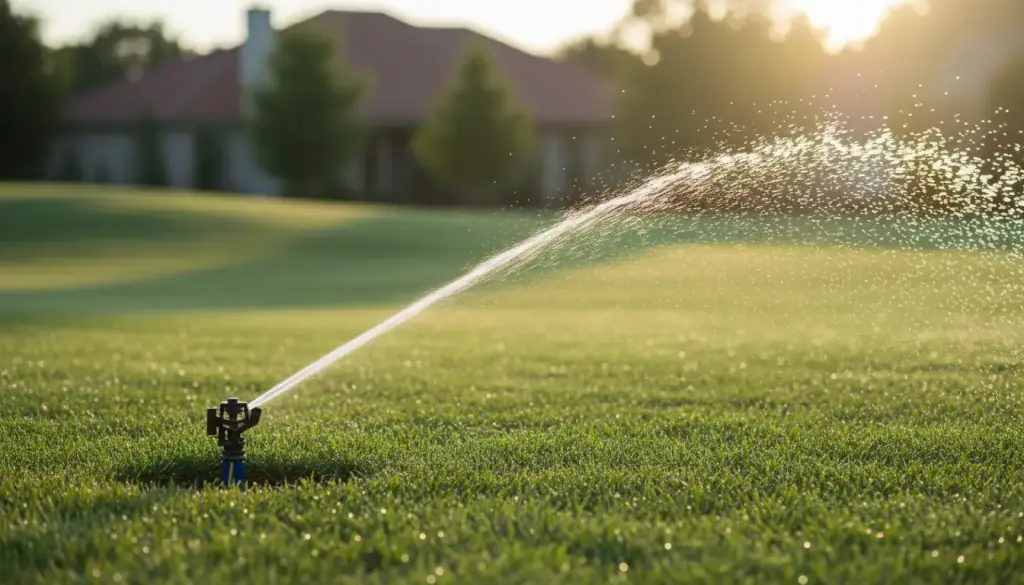
Almost every lawn in North Texas has one. The grass is green across most of the yard, and then there's a corner, or a strip beside the driveway, that turns straw-colored weeks before everything else. You've probably blamed the grass seed, the clay soil or the afternoon sun. Most of the time the cause is plainer than that. It sits in the layout of the sprinkler system, and some patch of ground simply isn't getting as much water as the rest.
Water has to overlap to come out even
A sprinkler head doesn't lay water down in a perfectly flat sheet. It tends to put more in the middle of its pattern and less toward the far edge of its throw. If heads are spaced so each one only just touches the next, those thin edges never get help, and the lawn ends up with heavy spots and light spots that repeat in a grid.
That's the reason good design starts with one rule: each head's spray should reach the next head. Irrigators call it head-to-head coverage. Every patch of turf gets water from more than one direction, the thin edges overlap, and the total lands much closer to even. Precision Irrigation Systems designs every new system this way and guarantees it in writing.
When spacing runs wider than the throw, you get dry bands between heads. You won't see them in spring, because grass forgives a lot. Then July arrives, the soil dries out, and the gaps show up as stripes or as a corner that gives up first.
Where the brown usually starts
If you walk the yard with a critical eye, the failing spots tend to fall into a few familiar places.
- Corners and lawn edges, where a head has to cover a quarter or half circle and the nozzle or arc doesn't quite match the shape of the turf.
- Strips along driveways and sidewalks, where the pattern was shortened to keep water off the pavement and nothing replaced the lost coverage.
- Ground behind a tree, a shrub or a raised bed that blocks the spray before it lands.
- The far end of a zone, where pressure is lowest and heads don't reach their full radius.
- Spots near a head that was replaced with a different type at some point and no longer matches its neighbors.
Rotors and spray heads don't belong on the same zone
Spray heads throw a short distance and deliver a lot of water fast. Rotors throw much farther and deliver it slowly over a wide area. Put both on one zone and the two fight each other. By the time the rotor side has had a useful soaking, the spray side has been running long enough to puddle and run off. Shorten the run time to save the spray side and the rotor side goes thirsty.
The fix is to give each zone one type of head with matched nozzles, so the whole zone gets water at roughly the same rate. Rotors usually earn their place on open turf. Spray heads suit small, tight, odd-shaped areas. One Google reviewer described a Precision crew choosing the more expensive rotary heads over spray heads for their yard purely because the rotors would work better there. That's the right instinct, and it's one a licensed irrigator makes with a tape measure in hand, not by default.
Why swing pipe matters more than it sounds
Swing pipe is a flexible connection between the buried line and the head. It lets the head sit at exactly the right height, and it gives the whole assembly a little room to move when the ground does. North Texas clay swells when it's wet and shrinks when it's dry, and rigid fittings take that punishment in the form of cracks, tilted heads and heads that sink below the grass line.
A tilted head throws water at the sky or at the neighbor's fence instead of across your turf. A sunken head fires into the blades of grass around it, and the pattern never makes it past its own rim. Either one creates a dry gap that looks, from the kitchen window, like a lawn problem. Every head Precision installs goes on a swing pipe mount for this reason.
Find the gap before it costs you grass
You can learn a lot about your own system in about an hour with a few shallow, straight-sided containers, like empty tuna cans. Set them in a line across a zone, run the zone for a measured time, and compare how much water each one caught. A wide difference between containers is a coverage problem, found without guessing.
- Run each zone by hand and watch it. Note any head that leans, sits low, sprays a fence or leaves a visible dry arc.
- Check that every head in a zone is the same type and puts out a similar pattern.
- Look for spray that stops short of the next head. That's a gap.
- Mark the brown spots on a rough sketch and note which zone sits nearest each one.
When a corner keeps coming back, it's worth having a licensed irrigator walk the zones with you. Precision Irrigation Systems designs new systems for head-to-head coverage, mounts every head on swing pipe and backs new installations with a 3-year written warranty. You can read how a design comes together on the irrigation installation page at /services/irrigation-installation, or call (469) 534-1100 for a free estimate. Every inquiry gets a reply within 24 hours.
Precision Irrigation Systems, (469) 534-1100
Call (469) 534-1100More articles
Drip irrigation for Dallas beds under twice-weekly watering rules
If your shrub beds struggle on a sprinkler schedule, putting the water at the roots may be the simpler answer.
Winterizing and spring setup for a North Texas sprinkler system
A little care at both ends of winter keeps cracked pipes and dead zones out of your first warm month.