French drain or lawn drainage? How to read where water pools around your house
The right drain depends on where the water starts, where it collects and where it needs to go.
October 14, 2026 · 4 min read
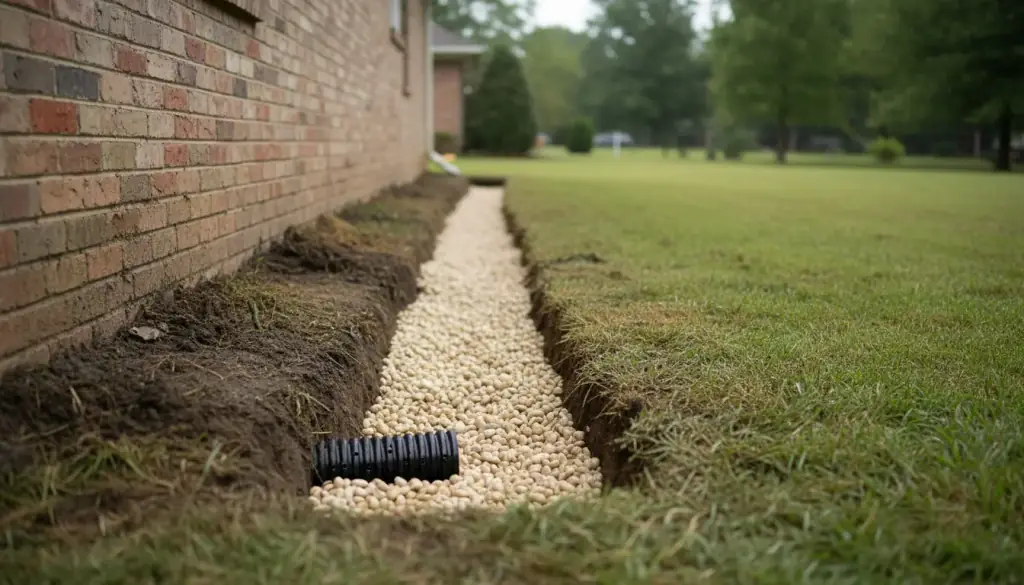
Water that sits against a house is rarely just a nuisance. It can find its way into the foundation, soften the soil beneath it and eventually show up as mold, cracks or damage inside the walls. A French drain and lawn drainage are two different answers to the same question, and picking the wrong one means paying for a fix that doesn't solve the problem. The way to choose is to work out where the water comes from first.
Start by watching the water
The best time to study a drainage problem is during or just after a heavy rain. Put on a jacket and walk the property. Note where water is flowing, where it slows down and where it sits. Take photos. A pool that disappears in an hour is a different problem from one that's still there the next afternoon.
Precision Irrigation Systems lists a handful of usual causes behind pooled water: runoff from the yard or from concrete, changes in elevation, downspout water, excess irrigation and poor soil. Most properties with trouble have more than one of those working together.
Downspouts and hard surfaces come first
A roof sheds a surprising amount of water in a single storm, and a downspout that empties beside the foundation puts all of it exactly where you don't want it. Look at where each one lands. If the splash is within a few feet of the wall, extending it or piping it away is often the cheapest fix there is.
Driveways, patios and walkways do the same thing on a smaller scale. They don't absorb anything, so the water they collect goes wherever the slope sends it. Check which direction each hard surface tilts. If it tilts toward the house, that's a clue.
Surface problem or subsurface problem
Here's the practical split. If water gathers in a low spot out in the yard and sits on top of the lawn, you're looking at a surface problem. The answer is lawn drainage: reshaping the slope, adding a swale or installing a catch basin so the water has a path out. Good drainage design accounts for soil type, plants, slope and where your sprinklers throw, since irrigation can feed the problem.
If the water is soaking into the ground next to the foundation, or the soil stays soggy long after the rain, that's often a subsurface problem. A French drain is built for it. A trench is dug along the problem area and filled with gravel around a perforated pipe, which gives water an easy route down and away. Precision builds custom residential French drains and larger systems for commercial foundations.
- Water standing on the lawn surface, away from the house: lawn drainage, such as regrading, a swale or a catch basin.
- Soggy soil along the foundation or under a flower bed: French drain.
- Water arriving from a downspout: extend or pipe the downspout, then check whether drainage is still needed.
- Water coming from a neighboring slope or a paved area: a drain placed to intercept it before it reaches the house.
- Pooling that tracks the sprinkler schedule: check the irrigation first.
Don't forget your own sprinklers
Excess irrigation is on the list for a reason. If sprinkler heads spray the wall of the house, or a zone runs long enough to saturate soil that was already wet, you're adding to the problem on a schedule. Look at where the wet spots appear relative to a zone. If they line up, adjusting the heads or the run time may help before any digging happens.
Why foundations are the real stake
Soil that swells and shrinks around a foundation puts it under uneven stress, and water that stays near the wall keeps that cycle going. The warning signs are mold, cracks in drywall or brick, and damp spots inside. By the time you see those, the water has been working on the problem for a while. Moving water away early is cheaper than any repair that comes after.
What to note before you call
- Where the water collects, with a photo or a quick sketch.
- How hard it rained and how long the water stayed.
- Where each downspout empties.
- Which direction the yard slopes near the house.
- Whether any sprinkler zone runs near the wet spot.
- Any interior signs, such as damp walls, cracks or a musty smell.
With that information a visit gets short and useful. Precision Irrigation Systems designs both kinds of fix, so you aren't steered toward one tool by default. See the French drains page at /services/french-drains and the lawn drainage page at /services/lawn-drainage, or call (469) 534-1100 for a free estimate. The office replies to every inquiry within 24 hours.
Precision Irrigation Systems, (469) 534-1100
Call (469) 534-1100More articles
Why one corner of your lawn always browns first
The patch that quits first in July is telling you something about how the sprinklers were laid out.
Drip irrigation for Dallas beds under twice-weekly watering rules
If your shrub beds struggle on a sprinkler schedule, putting the water at the roots may be the simpler answer.